
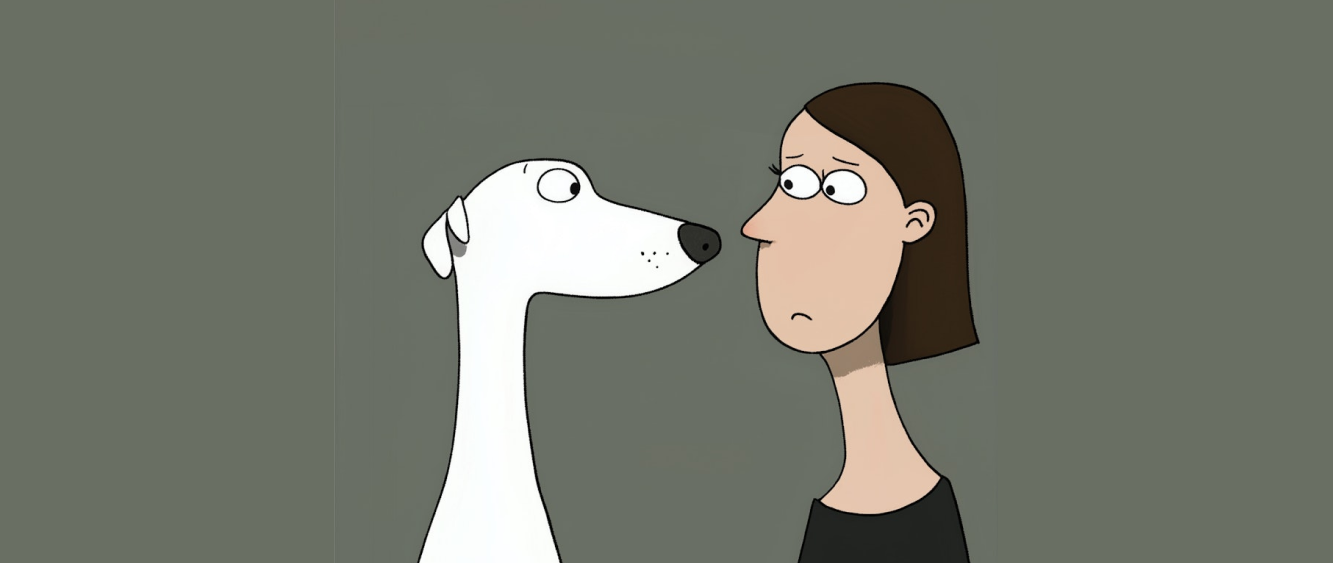
Dogs are a person’s best friends, no wonder the English language has plenty of idioms related to them. Do you think you know all of these idioms? There’s more, believe me…
Our love story with dogs began when our ancestors were still nomadic, about 15,000 years ago — maybe even earlier, as there’s evidence pointing out at domestication starting as back as 30,000 years . At that time our furry friends weren’t still able to wag their tails: they were much stronger and definitely wilder. They were wolves. According to recent scientific studies, they approached us because scavenging our preys proved less risky than hunting, and our fires kept them warm. They must have quickly perfected that cute “Feed me, human, I’m starving!” face, and with time they became more and more docile and friendly. The result is that, before inventing agriculture, languages, or permanent homes we started loving our dogs. And when we came up with languages, we stuffed them with idioms related to our four-legged moochers…

Let’s take a look at some of them:
If you’re feeling dog tired you are exhausted, just like a dog after a chase.
"He's dog-tired, sleeps all day, but is otherwise healthy," Nina said, after being reunited with him.
When something is going to the dogs, it’s getting comparably less successful than before.
“Without any notion of civic ownership, the place will clearly go to the dogs, what with people pulling their wheely cases everywhere and pinching gondolas without a care.”
If someone is in the doghouse, they are in disgrace and very unpopular at the moment.
“But after decades in the doghouse, old-fashioned rhubarb is in style again.”

Someone whose bark is worse than their bite may well get angry and shout, but doesn't take action.
“Over the past decade North Korea's string of nuclear provocations has reinforced the public conviction that Washington's bark is worse than its bite.”
If you’re barking up the wrong tree, you’re asking the wrong person; you’re making the wrong choice.
“In all seriousness, though, the military is barking up the wrong tree going after us lawyers.”
In a dog eat dog world, there is intense competition and rivalry, where everybody thinks only of themselves.
"You've got to understand something: Out here, the competition is cutthroat, dog-eat-dog.”

If you want to let sleeping dogs lie, you are trying to avoid restarting a conflict.
“In an article written for Conservative Home, Timothy, who was one of May's most senior advisers while she was home secretary, rejected calls to "let sleeping dogs lie" in relation to the events more than 30 years ago
This idiom means that everyone gets their moment to shine.
Every dog has its day, and these adorable pups are having theirs thanks to an awesome new Twitter feed.
Dog days are very hot summer days.
“’The dog days of summer are here!’ the message advised.”
You can't teach an old dog new tricks
It is difficult to make someone change the way they do something when they have been doing it the same way for a long time.
(I can confirm this saying is so damn true: I adopted my cute doggie when she was already an old lady, and there’s no way I can teach her to play with her toys: whenever I throw them at her she looks at me like I’m nuts. I’m pretty sure she thinks something like “Human, what’s wrong with you? They’re not my kibbles. How many times do I have to tell you: I want my treats, not this useless stuff!”)
"You can't teach an old dog new tricks," Mr. de Blasio said in response to the suggestion by Ms. Quinn that the department could reform certain practices while retaining Mr. Kelly.
I could go on and on adding even more sayings, but I’ll spare you. I guess you got it though: everything in English can be expressed with an idiom related to dogs!
Ludwig's wrap up
Let me just add one more thing, because there’s a mystery, and we all love mysteries: did you know the origin of the word dog is one of the great puzzles of English etymology? Linguists have not identified its roots, nor that of other animal-related words, such as pig, hog, and stag. Up until seven centuries ago, the word hound, from the Old English hund, (the general Germanic and Indo-European word, from root from PIE root * kwon-) was used for all domestic canines. Dog was just used to refer to a subgroup of hounds which includes the mastiff. According to some researchers, the sub-breed known as dogs became so populous that by the XVI century dog became the generic term. All we know is that it comes from Middle English dogge, from Old English dogga or docga, but where does dogga come from? Any ideas? I guess we can’t solve this enigma, so let’s just focus on what we can do and give some treats and cuddles to our furry friends!
Martha my dear - The Beatles. Urban legend has it that Martha was not a girl but Paul McCartney’s dog